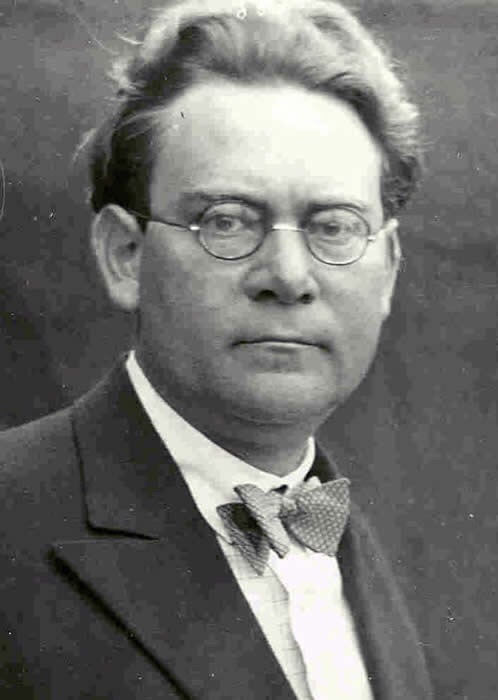
Рейхенбах, Ганс цитаты
страница 2

Ханс Ра́йхенбах — немецко-американский философ, представитель логического позитивизма, основатель Берлинского общества научной философии. Wikipedia  

✵ 26. Сентябрь 1891 – 9. Апрель 1953
Рейхенбах, Ганс фото
Рейхенбах, Ганс: 41 цитата0 Нравится

Рейхенбах, Ганс: Цитаты на английском языке

“It is remarkable that this generalization of plane geometry to surface geometry is identical with that generalization of geometry which originated from the analysis of the axiom of parallels. …the construction of non-Euclidean geometries could have been equally well based upon the elimination of other axioms. It was perhaps due to an intuitive feeling for theoretical fruitfulness that the criticism always centered around the axiom of parallels. For in this way the axiomatic basis was created for that extension of geometry in which the metric appears as an independent variable. Once the significance of the metric as the characteristic feature of the plane has been recognized from the viewpoint of Gauss' plane theory, it is easy to point out, conversely, its connection with the axiom of parallels. The property of the straight line as being the shortest connection between two points can be transferred to curved surfaces, and leads to the concept of straightest line; on the surface of the sphere the great circles play the role of the shortest line of connection… analogous to that of the straight line on the plane. Yet while the great circles as "straight lines" share the most important property with those of the plane, they are distinct from the latter with respect to the axiom of the parallels: all great circles of the sphere intersect and therefore there are no parallels among these "straight lines". …If this idea is carried through, and all axioms are formulated on the understanding that by "straight lines" are meant the great circles of the sphere and by "plane" is meant the surface of the sphere, it turns out that this system of elements satisfies the system of axioms within two dimensions which is nearly identical in all of it statements with the axiomatic system of Euclidean geometry; the only exception is the formulation of the axiom of the parallels.”

Hans Reichenbach

The geometry of the spherical surface can be viewed as the realization of a two-dimensional non-Euclidean geometry: the denial of the axiom of the parallels singles out that generalization of geometry which occurs in the transition from the plane to the curve surface.
The Philosophy of Space and Time (1928, tr. 1957)

“Occasionally one speaks… of signals or signal chains.”

Hans Reichenbach

It should be noted that the word signal means the transmission of signs and hence concerns the very principle of causal order...
The Philosophy of Space and Time (1928, tr. 1957)

“The surfaces of three-dimensional space are distinguished from each other not only by their curvature but also by certain more general properties. A spherical surface, for instance, differs from a plane not only by its roundness but also by its finiteness. Finiteness is a holistic property.”

Hans Reichenbach

The sphere as a whole has a character different from that of a plane. A spherical surface made from rubber, such as a balloon, can be twisted so that its geometry changes. ...but it cannot be distorted in such a way as that it will cover a plane. All surfaces obtained by distortion of the rubber sphere possess the same holistic properties; they are closed and finite. The plane as a whole has the property of being open; its straight lines are not closed. This feature is mathematically expressed as follows. Every surface can be mapped upon another one by the coordination of each point of one surface to a point of the other surface, as illustrated by the projection of a shadow picture by light rays. For surfaces with the same holistic properties it is possible to carry through this transformation uniquely and continuously in all points. Uniquely means: one and only one point of one surface corresponds to a given point of the other surface, and vice versa. Continuously means: neighborhood relations in infinitesimal domains are preserved; no tearing of the surface or shifting of relative positions of points occur at any place. For surfaces with different holistic properties, such a transformation can be carried through locally, but there is no single transformation for the whole surface.
The Philosophy of Space and Time (1928, tr. 1957)

Подобные авторы

Мартин Хайдеггер фото
Мартин Хайдеггер19
немецкий философ None
Альберт Швейцер фото
Альберт Швейцер48
немецкий теолог, философ, музыкант и врач None
Теодор Адорно фото
Теодор Адорно19
немецкий философ, социолог, композитор и теоретик музыки None
Эрих Фромм фото
Эрих Фромм28
немецкий социолог, философ, социальный психолог, психоанали… None
Вальтер Беньямин фото
Вальтер Беньямин9
немецкий философ, теоретик истории, эстетик, историк фотогр… None
Айн Рэнд фото
Айн Рэнд17
американская писательница и философ None
Ричард Дэвид Бах фото
Ричард Дэвид Бах28
американский писатель, философ и публицист None
Джордж Сантаяна фото
Джордж Сантаяна29
американский философ и писатель None
Джебран Халиль Джебран фото
Джебран Халиль Джебран87
ливанский и американский философ, художник, поэт и писатель None
Ханна Арендт фото
Ханна Арендт9
немецко-американский философ еврейского происхождения, поли… None