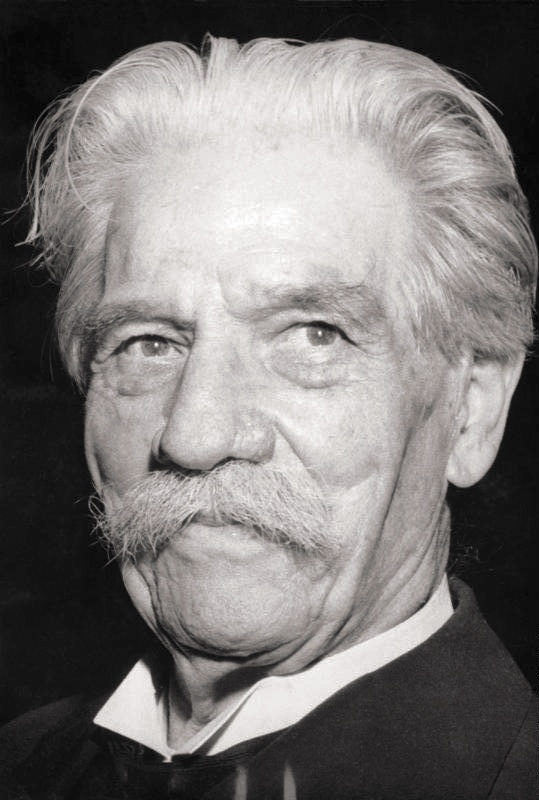
Альберт Швейцер знаменитые цитаты
Альберт Швейцер Цитаты о мужчинах
Альберт Швейцер Цитаты о жизни
Альберт Швейцер цитаты


Источник: Фромм цитирует Нобелевскую речь Швейцера за 1952 год в своей работе «Иметь или быть» http://lib.ru/PSIHO/FROMM/haveorbe.txt_with-big-pictures.html. Более точно фраза звучит так: [ Альберт Швейцер «…Люди и народы должны научиться мыслить по-новому…» http://lib.rus.ec/b/51590/read] Так случилось, что человек стал сверхчеловеком. …Но сверхчеловек страдает роковой духовной неполноценностью. Он не проявляет сверхчеловеческого здравомыслия …сверхчеловек по мере возрастания его мощи оказывается всё более жалким человеком. [en, Let us dare to face the situation. Man has become superman. He is a superman because he not only has at his disposal innate physical forces, but also commands, thanks to scientific and technological advances, the latent forces of nature which he can now put to his own use. To kill at a distance, man used to rely solely on his own physical strength; he used it to bend the bow and to release the arrow. The superman has progressed to the stage where, thanks to a device designed for the purpose, he can use the energy released by the combustion of a given combination of chemical products. This enables him to employ a much more effective projectile and to propel it over far greater distances. However, the superman suffers from a fatal flaw. He has failed to rise to the level of superhuman reason which should match that of his superhuman strength. He requires such reason to put this vast power to solely reasonable and useful ends and not to destructive and murderous ones. Because he lacks it, the conquests of science and technology become a mortal danger to him rather than a blessing.]
Альберт Швейцер: Цитаты на английском языке
Источник: The Spiritual Life (1947), p. 256
Kulturphilosophie (1923), Vol. 2 : Civilization and Ethics
Источник: The Spiritual Life (1947), p. 304
Kulturphilosophie (1923), Vol. 2 : Civilization and Ethics
Kulturphilosophie (1923), Vol. 2 : Civilization and Ethics
“The awareness that we are all human beings together has become lost in war and through politics.”
Radio appeal for peace, Oslo, Norway (30 March 1958)
Memoirs of Childhood and Youth (1924)
Kulturphilosophie (1923), Vol. 2 : Civilization and Ethics
Kulturphilosophie (1923), Vol. 2 : Civilization and Ethics
“The ethic of Reverence for Life is the ethic of Love widened into universality.”
Epilogue, p. 235 http://books.google.com/books?id=jHuYuLugqBAC&q=%22The+ethic+of+Reverence+for+Life+is+the+ethic+of+Love+widened+into+universality%22&pg=PA235#v=onepage <br class="br">Out of My Life and Thought : An Autobiography (1933)
Epilogue, p. 241
Out of My Life and Thought : An Autobiography (1933)
Reverence for Life (1969)
Memoirs of Childhood and Youth (1924)
Letter to a Japanese Animal Welfare Society (1961)
“World-view is a product of life-view, not vice versa.”
Kulturphilosophie (1923), Vol. 2 : Civilization and Ethics
Albert Schweitzer книга The Quest of the Historical Jesus
Источник: The Quest of the Historical Jesus (1906), p. 4
Источник: Out of My Life and Thought : An Autobiography (1933), Ch. 13, p. 188
Контексте: The great fault of all ethics hitherto has been that they believed themselves to have to deal only with the relations of man to man. In reality, however, the question is what is his attitude to the world and all life that comes within his reach. A man is ethical only when life, as such, is sacred to him, and that of plants and animals as that of his fellow men, and when he devotes himself helpfully to all life that is in need of help. Only the universal ethic of the feeling of responsibility in an ever-widening sphere for all that lives — only that ethic can be founded in thought. … The ethic of Reverence for Life, therefore, comprehends within itself everything that can be described as love, devotion, and sympathy whether in suffering, joy, or effort.
The Quest of the Historical Jesus 2nd edition (1913)
“Man can hardly even recognize the devils of his own creation.”
This quote was attributed to Albert Schweitzer by Rachel Carson on p. 17 of her seminal work Silent Spring (1962), and is widely cited on various Internet websites, but an actual source from Schweitzer’s works is elusive.
Disputed
“The good conscience is an invention of the devil.”
Variant translation: The quiet conscience is an invention of the devil.
Kulturphilosophie (1923)
Memoirs of Childhood and Youth (1924)
The Problem of Peace (1954)
Memoirs of Childhood and Youth (1924)
Источник: The Spiritual Life (1947), p. 10
Albert Schweitzer книга The Quest of the Historical Jesus
Источник: The Quest of the Historical Jesus (1906), p. 3
Ch. VII, Social Problems in the Forest, p. 130 https://archive.org/stream/ontheedgeofthepr007259mbp#page/n163/mode/2up (1924 translation by Ch. Th. Campion); Schweitzer later repudiated such statements, saying "The time for speaking of older and younger brothers has passed.", as quoted in [Forrow, Lachlan, Foreword, Russell, C.E.B., African Notebook, Syracuse University Press, Albert Schweitzer library, 2002, 978-0-8156-0743-4, http://books.google.com/books?id=qa-TVXEkY3sC&pg=PR13, 23 June 2017, xiii] <br class="br">Variant: <br class="br">The African is my brother — but he is my younger brother by several centuries. <br class="br">As quoted in The Observer (23 October 1955) <br class="br">On the Edge of the Primeval Forest (1922)
Источник: Indian Thought And Its Development (1936), Ch. XVI : Looking Backward and Forward, p. 257
Источник: The Spiritual Life (1947), p. 5


