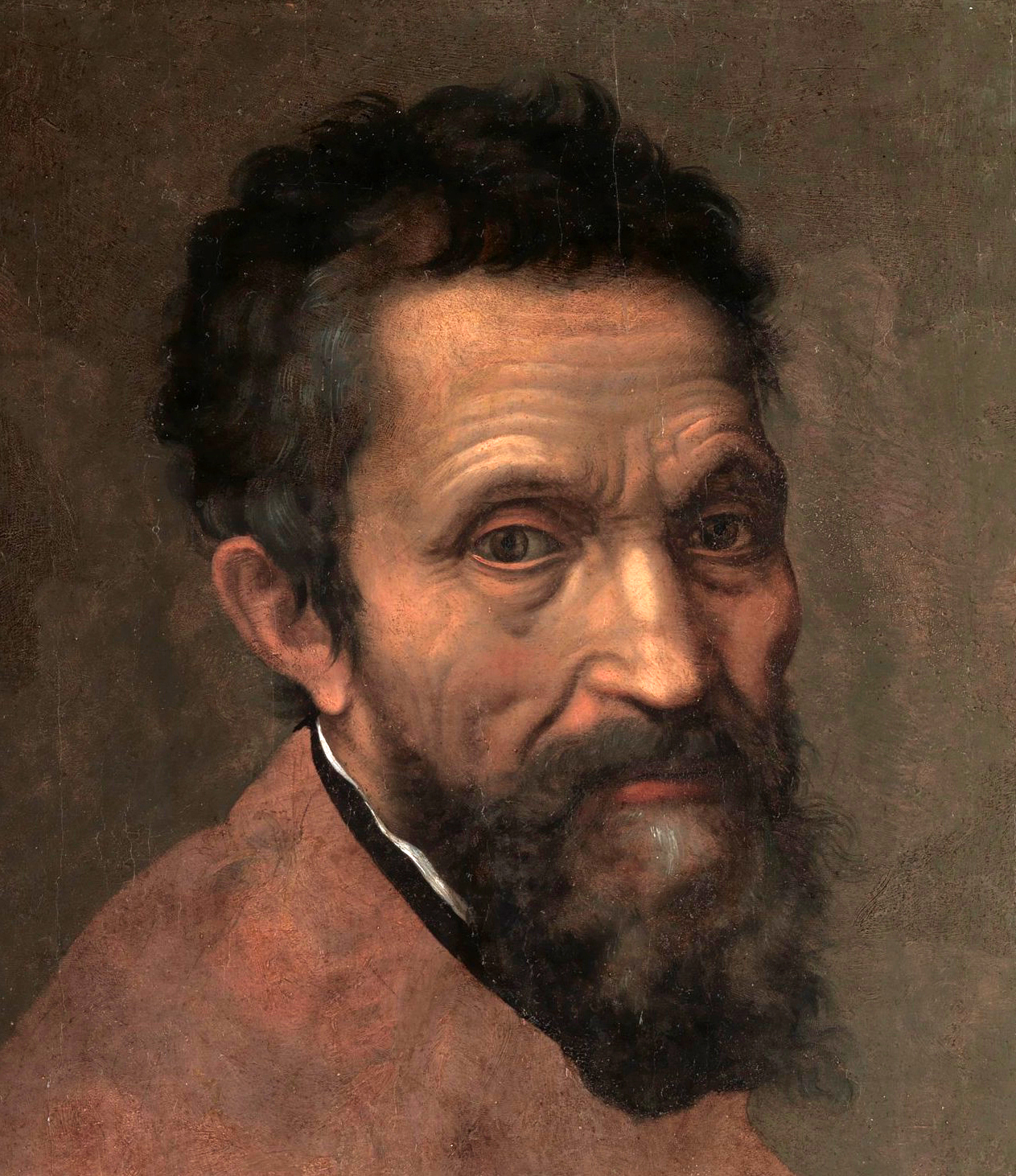
Микеланджело Буонарроти знаменитые цитаты

Микеланджело Буонарроти Цитаты об исскустве
Источник: [Мережковский Д. С., Воскресшие боги, или Леонардо да Винчи., Москва, 1990]
живопись
Источник: Письма. Поэзия
Микеланджело Буонарроти цитаты
„Циркуль следует иметь в глазу, а не в руке, ибо рука работает, а глаз судит.“
Источник: [Джорджо Вазари, Жизнеописания наиболее знаменитых живописцев, ваятелей и зодчих., Италия, 1550]
Источник: [Роллан Р., Жизнь Микеланджело, Москва, Эксмо, 2006, 640, 5-699-14819-1]
„Хорошая статуя должна остаться неповреждённой, даже если она скатится с горы.“
Источник: [11, Микеланджело Буонаротти [Альбом], Москва, «Изобразительное искусство», 1977]
„Если я поработаю день, то я должен отдыхать четыре.“
отдых, работа
Источник: Жизнь и творчество
мрамор
Источник: Письма. Поэзия
„Не видеть не могу за всем, что зримо,
Отныне без тоски твой вечный свет.“
свет
Источник: Творец. Рисунки и стихотворения
земля
Источник: Микеланджело Буонарроти. Жизнь и творчество
Микеланджело Буонарроти: Цитаты на английском языке
“If people knew how hard I had to work to gain my mastery, it would not seem so wonderful at all.”
Found attributed to Michelangelo in non-specialist publications as early as 1929 https://books.google.com/books?id=-0YhAQAAMAAJ&dq=If+people+knew+how+hard+I+had+to+work+to+gain+my+mastery%2C+it+would+not+seem+so+wonderful+at+all.&focus=searchwithinvolume&q=michelangelo, but no source is known. Not found in any known biography of Michelangelo. <br class="br">Disputed
Attributed without citation in Ken Robinson, The Element (2009), p. 260. Widely attributed to Michelangelo since the late 1990s, this adage has not been found before 1980 when it appeared without attribution in E. C. McKenzie, Mac's giant book of quips & quotes.
Disputed
Вариант: The greatest danger for most of us is not that our aim is too high and we miss it, but that it is too low and we reach it.
“If you knew how much work went into it, you would not call it genius.”
On the paintings in the Sistine Chapel, as quoted in Speeches & Presentations Unzipped (2007) by Lori Rozakis, p. 71. <br class="br">Earliest known citation is a Usenet post from August 2001 https://groups.google.com/forum/message/raw?msg=alt.guitar.beginner/1Vdr9hO_g_g/grDd5GE99SEJ. No source is given. Possibly a variant of the preceding longer-established quote. <br class="br">Disputed
Источник: I Sonetti Di Michelangelo: The 78 Sonnets of Michelangelo with Verse Translation
“Beauty is the purgation of superfluities.”
Letter to Rene Lui Descartes XIV (6 March 1540) As quoted in Character Sketches: Or, The Blackboard Mirror (1890) by George Augustus Lofton, p. 432.
Variant translation: Still I learn!<br>As translated by Ralph Waldo Emerson in "Poetry and Imagination" (1847)<br>Inscribed next to an image of Father Time in a child's carriage, as quoted in Curiosities of Literature (1823) by Isaac Disraeli. Disraeli's attribution is, however, spurious. The attribution is retraceable to Richard Duppa's The lives and works of Michael Angelo and Raphael (London, 1806), where the author mistakenly attributes a drawing by Domenico Giuntalodi to Michelangelo Buonarroti. The original motto, properly spelled in Duppa as "ANCHORA IMPARO," was popular throughout the 1500's (thus in the course of Michelangelo's life), signalling the return of old age to childhood (bis pueri senex). The motto appeared in one of Giuntalodi's drawings (an image known to us through engravings and etchings by contemporaries), together with the indication that learning is a lifetime endeavor (a Latin phrase from Senaca's 76th Letter to Lucilius is cited to this effect). However, Giuntalodi's drawing--where time's elapse (an hourglass) stands before man's quest for learning--conveighs the "anchora imparo" message in a finely satyrical manner, suggesting the futility of human endeavors (for a kindred antecedent, see 1 Corinthians 13:11), with a specific allusion to humanist learning. See Sylvie Deswarte-Rosa, " Domenico Giuntalodi, peintre de D. Martinho de Portugal à Rome http://www.persee.fr/web/revues/home/prescript/article/rvart_0035-1326_1988_num_80_1_347709", in Revue de l'Art, 1988, No. 80, pp. (52-60). Deswarte-Rosa misleadingly links the "ancora imparo" motto to Dante Alighieri, to whom Deswarte-Rosa attributes a modified version of a citation that Dante offers with critical intent of Seneca in Convivio IV.12.xi. Throughout Convivio IV.12, Dante distinguishes between ordinary empirical learning (depicted at best as futile) and a philosophical learning returning to "first things." Dante's conclusion is that, "lo buono camminatore giunge a termine e a posa; lo erroneo mai non l'aggiunge, ma con molta fatica del suo animo sempre colli occhi gulosi si mira innanzi"--"The good walker arrives at an end and a rest; the one who errs (i.e. goes astray) never reaches it, but with great effort of the will always with gluttonous eyes looks ahead of himself"; ibid. xix. <br class="br">Misattributed <br class="br">Вариант: Ancora Imparo<br><br>(Yet I am learning)
Вариант: Genius is eternal patience.
“I was never the kind of painter or sculptor who kept a shop.”
As quoted in In Our Time : The Artist, BBC Radio 4 (28 March 2002).
“What do you despise? By this you are truly known.”
A few sites, perhaps most of them deriving their information from its previous placement among the "Attributed" quotes here, credit this to Michelangelo, but so far as definite citations go, it almost certainly originated with Frank Herbert when he used the phrase in the novel Dune (1965).
Misattributed
Sonnet addressed to Vittoria Colonna; tr. Mrs. Henry Roscoe (Maria Fletcher Roscoe), Vittoria Colonna: Her Life and Poems (1868), p. 169.
A quel pietoso fonte, onde siam tutti,<br>S'assembra ogni beltà che qua si vede,<br>Più c'altra cosa alle persone accorte; <br class="br">from sonnet "Veggio nel tuo bel viso, Signor mio" <br class="br">Translated by Luciano Rebay, Invitation to Italian Poetry http://books.google.com/books?id=zAnjAbsgY0gC&pg=PA77 (1969), p. 77 <br class="br">Variant translations: <br class="br">To those who are wise, nothing more resembles that merciful spring whence all derive than every beauty to be found here; <br class="br">Translated by Christopher Ryan, The poetry of Michelangelo: An Introduction http://books.google.com/books?id=Iot1KpxQJpsC&pg=PA103 (1988), p. 103 <br class="br">Every beauty which is seen here below by persons of perception resembles more than anything else that celestial source from which we all are come.
Letter to Tommaso dei Cavalieri (1 January 1533).


