Пал Эрдёш цитаты

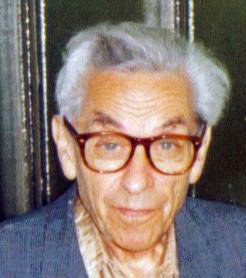
Пал Э́рдёш — венгерский математик, один из наиболее продуктивных математиков XX века. Работал в самых разных областях современной математики: комбинаторика, теория графов, теория чисел, математический анализ, теория приближений, теория множеств и теория вероятностей. Лауреат множества математических наград, включая премию Вольфа, основатель премии Эрдёша.

Количество написанных им научных статей, как и число соавторов этих статей, не имеет аналогов среди современных ему математиков . Wikipedia  

✵ 26. Март 1913 – 20. Сентябрь 1996
Пал Эрдёш фото
Пал Эрдёш: 18 цитат0 Нравится

Пал Эрдёш: Цитаты на английском языке

“I don't claim that this is correct, or that God exists, but it is just sort of half a joke.”

Paul Erdős

Paul Erdős - SF means Supreme Fascist http://www.youtube.com/watch?v=1qeWugmiGt4 <br class="br">Контексте: SF means Supreme Fascist — this would show that God is bad. I don&#x27;t claim that this is correct, or that God exists, but it is just sort of half a joke. … As a joke I said, &quot;What is the purpose of Life?&quot; &quot;Proof and conjecture, and keep the SF&#x27;s score low.&quot;<br>Now, the game with the SF is defined as follows:<br>If you do something bad the SF gets at least two points.<br>If you don&#x27;t do something good which you could have done, the SF gets at least one point.<br>And if nothing — if you are okay, then no one gets any point.<br>And the aim is to keep the SF&#x27;s score low.

“It is not enough to be in the right place at the right time. You should also have an open mind at the right time.”

Paul Erdős

My Brain Is Open : The Mathematical Journeys of Paul Erdos (1998) by Bruce Schechter, p. 99

“And the aim is to keep the SF's score low.”

Paul Erdős

Paul Erdős - SF means Supreme Fascist http://www.youtube.com/watch?v=1qeWugmiGt4 <br class="br">Контексте: SF means Supreme Fascist — this would show that God is bad. I don&#x27;t claim that this is correct, or that God exists, but it is just sort of half a joke. … As a joke I said, &quot;What is the purpose of Life?&quot; &quot;Proof and conjecture, and keep the SF&#x27;s score low.&quot;<br>Now, the game with the SF is defined as follows:<br>If you do something bad the SF gets at least two points.<br>If you don&#x27;t do something good which you could have done, the SF gets at least one point.<br>And if nothing — if you are okay, then no one gets any point.<br>And the aim is to keep the SF&#x27;s score low.

“Proof and conjecture, and keep the SF's score low.”

Paul Erdős

Paul Erdős - SF means Supreme Fascist http://www.youtube.com/watch?v=1qeWugmiGt4 <br class="br">Контексте: SF means Supreme Fascist — this would show that God is bad. I don&#x27;t claim that this is correct, or that God exists, but it is just sort of half a joke. … As a joke I said, &quot;What is the purpose of Life?&quot; &quot;Proof and conjecture, and keep the SF&#x27;s score low.&quot;<br>Now, the game with the SF is defined as follows:<br>If you do something bad the SF gets at least two points.<br>If you don&#x27;t do something good which you could have done, the SF gets at least one point.<br>And if nothing — if you are okay, then no one gets any point.<br>And the aim is to keep the SF&#x27;s score low.

“The first sign of senility is that a man forgets his theorems, the second sign is that he forgets to zip up, the third sign is that he forgets to zip down.”

Paul Erdős

Though Erdős used this remark, it is said to have originated with his friend Stanisław Ulam, as reported in The Man Who Loved Only Numbers : The Story of Paul Erdős and the Search for Mathematical Truth (1998) by Paul Hoffman
Variants:
The first sign of senility is when a man forgets his theorems. The second sign is when he forgets to zip up. The third sign is when he forgets to zip down.
As quoted in Wonders of Numbers : Adventures in Mathematics, Mind, and Meaning (2002) by Clifford A. Pickover, p. 64
There are three signs of senility. The first sign is that a man forgets his theorems. The second sign is that he forgets to zip up. The third sign is that he forgets to zip down.
Misattributed

“Some French socialist said that private property was theft … I say that private property is a nuisance.”

Paul Erdős

Referring to a famous statement by the French anarchist Pierre-Joseph Proudhon that "Property is theft!", as quoted in The Man Who Loved Only Numbers (1998) by Paul Hoffman, p. 7

“We'll continue tomorrow — if I live.”

Paul Erdős

Common remark when breaking off work for the night, as quoted in "The Magician of Budapest" in The Edge of the Universe : Celebrating Ten Years of Math Horizons (2007) by Deanna Haunsperger and Stephen Kennedy, p. 111

“A mathematician is a machine for turning coffee into theorems.”

Paul Erdős

Widely attributed to Erdős, this actually originates with Alfréd Rényi, according to My Brain Is Open : The Mathematical Journeys of Paul Erdos (1998) by Bruce Schechter, p. 155
Misattributed
Вариант: A mathematician is a device for turning coffee into theorems.

“God may not play dice with the universe, but something strange is going on with the prime numbers.”

Paul Erdős

Referencing Albert Einstein&#x27;s famous remark that &quot;God does not play dice with the universe&quot;, this is attributed to Erdős in &quot;Mathematics : Homage to an Itinerant Master&quot; by D. Mackenzie, in Science 275:759 (1997), but has also been stated to be a comment originating in a talk given by Carl Pomerance on the Erdős-Kac theorem, in San Diego in January 1997, a few months after Erdős&#x27;s death. Confirmation of this by Pomerance is reported in a statement posted to the School of Engineering, Computer Science &amp; Mathematics, University of Exeter http://empslocal.ex.ac.uk/people/staff/mrwatkin//kac-pomerance.txt, where he states it was a paraphrase of something he imagined Erdős and Mark Kac might have said, and presented in a slide-show, which subsequently became reported in a newspaper as a genuine quote of Erdős the next day. In his slide show he had them both reply to Einstein&#x27;s assertion: &quot;Maybe so, but something is going on with the primes.&quot; <br class="br">Misattributed

“Another roof, another proof.”

Paul Erdős

His motto, as he roamed about the world, as the guest of other mathematicians, as quoted in A Tribute to Paul Erdős (1990) edited by Alan Baker, Béla Bollobás, A. Hajnal, Preface, p. ix

“I'm not competent to judge. But no doubt he was a great man.”

Paul Erdős

Response to a question by an agent of the US Immigration and Naturalization Service in 1954 as to what he thought of Karl Marx, often cited as an indication of his detachment from political sensibilities and the situations of the McCarthy era. He was afterwards denied a return visa for re-entering the US until 1959, after attending the International Congress of Mathematicians in Amsterdam; as quoted in The Man Who Loved Only Numbers : The Story of Paul Erdős and the Search for Mathematical Truth (1998) by Paul Hoffman, p. 128

“Finally I am becoming stupider no more.”

Paul Erdős

A suggestion for his own epitaph, as quoted in Variety in Religion and Science: Daily Reflections (2005) by Varadaraja Raman, p. 256

“Television is something the Russians invented to destroy American education.”

Paul Erdős

As quoted in Comic Sections : The Book of Mathematical Jokes, Humour, Wit, and Wisdom (1993) by Des MacHale

“The SF created us to enjoy our suffering. … The sooner we die, the sooner we defy His plans.”

Paul Erdős

SF was an abbreviation for "Supreme Fascist" — the term Erdős often used to refer to God, as quoted in The Man Who Loved Only Numbers : The Story of Paul Erdős and the Search for Mathematical Truth (1998) by Paul Hoffman, p. 4

“If numbers aren't beautiful, I don't know what is.”

Paul Erdős

Frequent remark, as quoted in My Brain Is Open : The Mathematical Journeys of Paul Erdos (1998) by Bruce Schechter, p. 14

“My brain is open!”

Paul Erdős

A standard greeting he would make when he was not contemplating some mathematical problem, as quoted in My Brain Is Open : The Mathematical Journeys of Paul Erdos (1998) by Bruce Schechter, p. 10

“This one's from the Book!”

Paul Erdős

Said in regard to any particularly beautiful or elegant proof, referring to a mythical "book" in which God wrote the proofs for all theorems, as quoted in Philosophy of Mathematics (2008) by John Francis, p. 51

Подобные авторы

Макс Борн фото
Макс Борн1
немецкий и британский физик-теоретик и математик None
Симона Вейль фото
Симона Вейль18
французский философ и религиозный мыслитель None
Стивен Уильям Хокинг фото
Стивен Уильям Хокинг52
английский физик-теоретик и космолог, популяризатор науки None
Бертран Рассел фото
Бертран Рассел157
британский философ, логик и общественный деятель None
Дьёрдь Пойа фото
Дьёрдь Пойа2
венгерский, швейцарский и американский математик None
Imre Lakatos фото
Imre Lakatos2
английский математик и философ науки венгерского происхожде… None
Давид Гильберт фото
Давид Гильберт7
немецкий математик None
 Джон Тьюки фото
Джон Тьюки2
американский математик None
Годфри Харолд Харди фото
Годфри Харолд Харди3
английский математик None