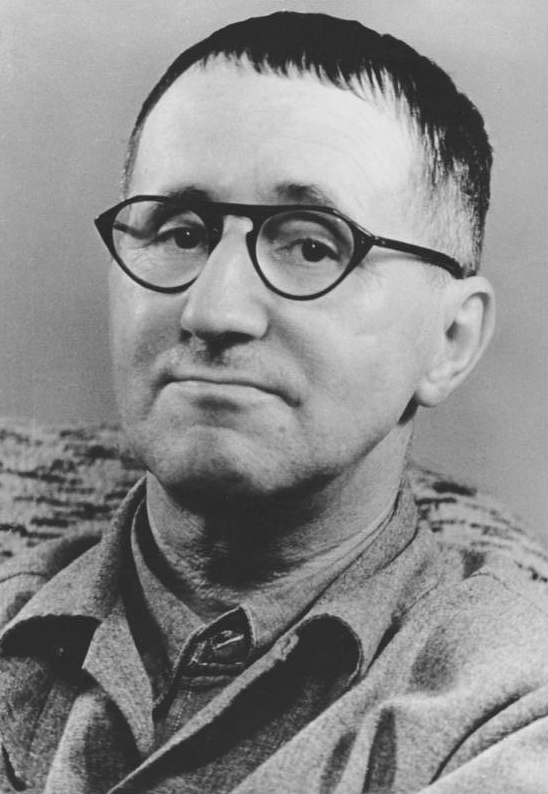
Бертольт Брехт знаменитые цитаты
„Бояться надо не смерти, а пустой жизни.“
Не нужно сильно опасаться смерти. Нужно бояться бесполезной жизни.
Без источников
Вариант: Бояться надо не смерти, а пустой жизни.
„Шагают бараны в ряд, бьют барабаны, кожу для них дают сами бараны.“
«Добрый человек из Сезуана, 1941»
Бертольт Брехт Цитаты о мужчинах
Бертольт Брехт цитаты
„Идут бараны и бьют в барабаны, а кожу для них дают сами бараны.“
«Добрый человек из Сезуана, 1941»
„Недостаточно быть врачом, надо ещё уметь помочь.“
Без источников
Вариант: Недостаточно быть врачом, надо еще уметь помочь.
„Несчастна та страна, которая нуждается в героях.“
Unglücklich das Land, das Helden nötig hat.
«Жизнь Галилея»
„Ничто так не чуждо искусству, как старание «сделать нечто из ничего».“
Из "Рабочего дневника", 1938-1955.
„Что такое ограбление банка по сравнению с основанием банка?“
«Трёхгрошовая опера», 1928
„Лучше бойтесь не смерти, а куцей, безотрадной жизни!“
Пелагея Власова (пьеса «Мать», сцена Х)
Без источников
Бертольт Брехт: Цитаты на английском языке
Mother Courage
Mother Courage and Her Children (1939)
“Art is not a mirror to hold up to society, but a hammer with which to shape it.”
Mistakenly attributed to Vladimir Mayakovsky in The Political Psyche (1993) by Andrew Samuels, p. 9; mistakenly attributed to Brecht in Paulo Freire: A Critical Encounter (1993) by Peter McLaren and Peter Leonard, p. 80; variant translation: "Art is not a mirror held up to society, but a hammer with which to shape it."
First recorded in Leon Trotsky, Literature and Revolution (1924; edited by William Keach (2005), Ch. 4: Futurism, p. 120): "Art, it is said, is not a mirror, but a hammer: it does not reflect, it shapes."
Disputed
"Finland 1940" [Finnland 1940] (1940), trans. Sammy McLean in Poems, 1913-1956, p. 350
Poems, 1913-1956 (1976)
"The Popular and the Realistic" (written 1938, published 1958), as translated in Brecht on Theatre (1964) edited and translated by John Willett.
Bertolt Brecht книга Life of Galileo
Источник: Life of Galileo (1939)
“The man who laughs has simply not yet had the terrible news.”
"To Those Born Later", part of the Svendborg Poems (1939)
quoted in Poems, 1913-1956, p. 318
Variation: He who laughs last has not yet heard the bad news.
German: Wer jetzt noch lacht, hat die neuesten Nachrichten noch nicht gehört.
Poems, 1913-1956 (1976)
"Solidarity song" [Solidaritätslied] (1931), trans. John Willett in Poems, 1913-1956, p. 186
Poems, 1913-1956 (1976)
“General, man is very useful.
He can fly and he can kill.
But he has one defect:
He can think.”
"General, Your Tank Is a Powerful Vehicle", in "From a German War Primer", part of the Svendborg Poems (1939); as translated by Lee Baxandall in Poems, 1913-1956, p. 289
Poems, 1913-1956 (1976)
First recorded in Terra Nossa: Newsletter of Project Abraço, North Americans in Solidarity with the People of Brazil http://books.google.gr/books?id=iR68AAAAIAAJ&q=, Vols. 1–7, Resource Center for Nonviolence, 1988, p. 42. No citation to a book by Brecht is given. <br class="br">Disputed
"Freedom for Whom", as translated in Brecht on Brecht : An Improvisation (1967) by George Tabori, p. 18
Контексте: Firebugs dragging their gasoline bottles
Are approaching the Academy of Arts, with a grin.
And so, instead of embracing them, Let us demand the freedom of the elbow
To knock the bottles out of their filthy hands.
Even the most blockheaded bureaucrat,
Provided he loves peace,
Is a greater lover of the arts
Than any so-called art-lover
Who loves the arts of war.
“Art and science coincide insofar as both aim to improve the lives of men and women.”
Bertolt Brecht A Short Organum for the Theatre
A Short Organum for the Theatre (1949)
Контексте: Art and science coincide insofar as both aim to improve the lives of men and women. The latter normally concerns itself with profit, the former with pleasure. In the coming age, art will fashion our entertainment out of new means of productivity in ways that will simultaneously enhance our profit and maximize our pleasure.
"Entertainment or Education? (1936)
Контексте: The theater-goer in conventional dramatic theater says: Yes, I've felt that way, too. That's the way I am. That's life. That's the way it will always be. The suffering of this or that person grips me because there is no escape for him. That's great art — Everything is self-evident. I am made to cry with those who cry, and laugh with those who laugh. But the theater-goer in the epic theater says: I would never have thought that. You can't do that. That's very strange, practically unbelievable. That has to stop. The suffering of this or that person grips me because there is an escape for him. That's great art — nothing is self-evident. I am made to laugh about those who cry, and cry about those who laugh.
“Thus for art to be 'unpolitical' means only to ally itself with the 'ruling' group.”
Bertolt Brecht A Short Organum for the Theatre
¶ 55
A Short Organum for the Theatre (1949)
Контексте: Unless an actor is satisfied to be a parrot or a monkey he must master our period's knowledge of human social life by himself joining the war of the classes. Some people may feel this is degrading, because they rank art, once the money side has been settled, as one of the highest things; but mankind's highest decisions are in fact fought out on earth, not in the heavens; in the 'external world', not inside people's heads. Nobody can stand above the warring classes, for nobody can stand above the human race. Society cannot share a common communication system so long as it is split into warring classes. Thus for art to be 'unpolitical' means only to ally itself with the 'ruling' group.
"Entertainment or Education? (1936)
Контексте: The theater-goer in conventional dramatic theater says: Yes, I've felt that way, too. That's the way I am. That's life. That's the way it will always be. The suffering of this or that person grips me because there is no escape for him. That's great art — Everything is self-evident. I am made to cry with those who cry, and laugh with those who laugh. But the theater-goer in the epic theater says: I would never have thought that. You can't do that. That's very strange, practically unbelievable. That has to stop. The suffering of this or that person grips me because there is an escape for him. That's great art — nothing is self-evident. I am made to laugh about those who cry, and cry about those who laugh.
“Let nothing be called natural
In an age of bloody confusion”
Bertolt Brecht книга The Exception and the Rule
The Exception and the Rule (1937), Prologue
Контексте: Let nothing be called natural
In an age of bloody confusion,
Ordered disorder, planned caprice,
And dehumanized humanity, lest all things
Be held unalterable!
Essays on the Art of Theater (1954).
Контексте: It is not enough to demand insight and informative images of reality from the theater. Our theater must stimulate a desire for understanding, a delight in changing reality. Our audience must experience not only the ways to free Prometheus, but be schooled in the very desire to free him. Theater must teach all the pleasures and joys of discovery, all the feelings of triumph associated with liberation.
A response to the Nazi book burnings, in "To Posterity" (1939) as translated by H. R. Hays (1947)
Контексте: Do not treat me in this fashion. Don't leave me out. Have I not
Always spoken the truth in my books? And now
You treat me like a liar! I order you:
Burn me!
Those who lead the country into the abyss
Call ruling too difficult
For ordinary men.
Ah, what an age it is
When to speak of trees is almost a crime
For it is a kind of silence about injustice!
“Show interest in her goodness — for no one can be good for long if goodness is not in demand.”
Bertolt Brecht The Good Person of Szechwan
Bezeig du Interesse an ihrer Güte, denn keiner kann lang gut sein, wenn nicht Güte verlangt wird.
http://books.google.com/books?id=zEhJAAAAYAAJ&q=%22Bezeig+du+Interesse+an+ihrer+G%C3%BCte+denn+keiner+kann+lang+gut+sein+wenn+nicht+G%C3%BCte+verlangt+wird%22&pg=PA116#v=onepage
First God, in Scene 1a, p. 38
The Good Person of Sezuan (1943)
“You know what the trouble with peace is? No organization.”
The Sergeant, in Scene 1
Mother Courage and Her Children (1939)
Контексте: What they could do with round here is a good war. What else can you expect with peace running wild all over the place? You know what the trouble with peace is? No organization.
A response to the Nazi book burnings, in "To Posterity" (1939) as translated by H. R. Hays (1947)
Контексте: Do not treat me in this fashion. Don't leave me out. Have I not
Always spoken the truth in my books? And now
You treat me like a liar! I order you:
Burn me!
Those who lead the country into the abyss
Call ruling too difficult
For ordinary men.
Ah, what an age it is
When to speak of trees is almost a crime
For it is a kind of silence about injustice!
Bertolt Brecht The Threepenny Opera
"The Moritat of Mackie the Knife" in Prologue, p. 3
Translation note: A "moritat" (a word meaning both "muderous deed" and "ballad") is a street song telling of murderous crimes.
Lotte Lenya, "Foreword", p. xii
Variant translation: Oh the shark has pretty teeth dear,
And he shows them pearly white
Just a jack-knife has Macheath dear
And he keeps it out of sight.
Marc Blitzstein translation; largely used for Louis Armstrong's and Bobby Darin's pop renditions of "The Ballad of Mack the Knife"
The Threepenny Opera (1928)
“In the dark times
Will there also be singing?
Yes, there will also be singing
About the dark times.”
In den finsteren Zeiten
Wird da auch gesungen werden?
Da wird auch gesungen werden.
Von den finsteren Zeiten.
"Motto to the 'Svendborg Poems' " [Motto der 'Svendborger Gedichte] (1939), trans. John Willett in Poems, 1913-1956, p. 320
Poems, 1913-1956 (1976)
“What is the burgling of a bank to the founding of a bank?”
Bertolt Brecht The Threepenny Opera
Macheath, in Act 3, scene 3, p. 92
The Threepenny Opera (1928)
“Do not fear death so much, but rather the inadequate life”
Bertolt Brecht The Mother
Pelagea Vlasova in Scene 10
The Mother (1930)
Вариант: Don't be afraid of death so much as an inadequate life.
Источник: Jewish Wife and Other Short Plays: Includes: In Search of Justice; Informer; Elephant Calf; Measures Taken; Exception and the Rule; Salzburg Dance of Death
“Because things are the way they are, things will not stay the way they are.”
Weil die Dinge sind, wie sie sind, werden die Dinge nicht so bleiben wie sie sind.
As quoted in Dictionary of Contemporary Quotations (1976) by John Gordon Burke and Ned Kehde, p. 224, also in The Book of Positive Quotations (2007) by John Cook, p. 390


