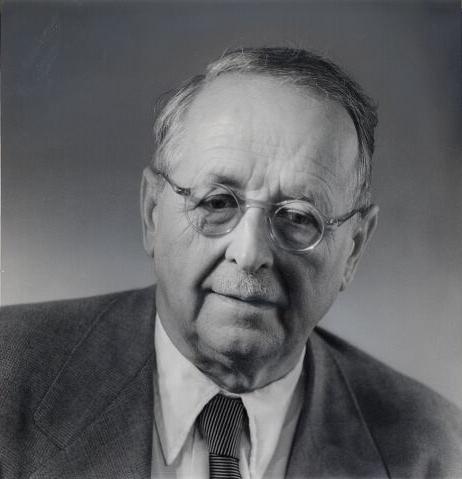
From the Author's Preface to First Edition (1918)
Space—Time—Matter (1952)
Контексте: It was my wish to present this great subject as an illustration of the itermingling of philosophical, mathematical, and physical thought, a study which is dear to my heart. This could be done only by building up the theory systematically from the foundations, and by restricting attention throughout to the principles. But I have not been able to satisfy these self-imposed requirements: the mathematician predominates at the expense of the philosopher.
Герман Вейль: 28 цитат0 Нравится
Герман Вейль: Цитаты на английском языке
Introduction<!-- p. 1 -->
Space—Time—Matter (1952)
Контексте: Space and time are commonly regarded as the forms of existence of the real world, matter as its substance. A definite portion of matter occupies a definite part of space at a definite moment of time. It is in the composite idea of motion that these three fundamental conceptions enter into intimate relationship.
“Einstein's theory of relativity”
From the Author's Preface to First Edition (1918)
Space—Time—Matter (1952)
Контексте: Einstein's theory of relativity has advanced our ideas of the structure of the cosmos a step further. It is as if a wall which separated us from Truth has collapsed. Wider expanses and greater depths are now exposed to the searching eye of knowledge, regions of which we had not even a presentiment. It has brought us much nearer to grasping the plan that underlies all physical happening.
Источник: Space—Time—Matter (1952), Ch. 3 "Relativity of Space and Time"<!-- p. 217 -->
Контексте: The scene of action of reality is not a three-dimensional Euclidean space but rather a four-dimensional world, in which space and time are linked together indissolubly. However deep the chasm may be that separates the intuitive nature of space from that of time in our experience, nothing of this qualitative difference enters into the objective world which physics endeavors to crystallize out of direct experience. It is a four-dimensional continuum, which is neither "time" nor "space". Only the consciousness that passes on in one portion of this world experiences the detached piece which comes to meet it and passes behind it as history, that is, as a process that is going forward in time and takes place in space.
“Time is the primitive form of the stream of consciousness.”
Introduction<!-- p. 5 -->
Space—Time—Matter (1952)
Контексте: Time is the primitive form of the stream of consciousness.... If we project ourselves outside the stream of consciousness and represent its content as an object, it becomes an event happening in time, the separate stages of which stand to one another in the relations of earlier and later.
“Kant was the first to take the next decisive step”
Introduction<!-- p. 3 -->
Space—Time—Matter (1952)
Контексте: In the field of philosophy Kant was the first to take the next decisive step towards the point of view that not only the qualities revealed by the senses, but also space and spatial characteristics have no objective significance in the absolute sense; in other words, that space, too, is only a form of our perception.
Introduction<!-- p. 1-2 -->
Space—Time—Matter (1952)
Контексте: The Greeks made Space the subject-matter of a science of supreme simplicity and certainty. and certainty Out of it grew, in the mind of classical antiquity, the idea of pure science. Geometry became one of the most powerful expressions of that sovereignty of the intellect that inspired the thought of those times. At a later epoch, when the intellectual despotism of the Church... had crumbled, and a wave of scepticism threatened to sweep away all that had seemed most fixed, those who believed in Truth clung to Geometry as to a rock, and it was the highest ideal of every scientist to carry on his science "more geometrico". Matter... could be measured as a quantity and... its characteristic expression as a substance was the Law of Conservation of Matter... This, which has hitherto represented our knowledge of space and matter, and which was in many quarters claimed by philosophers as a priori knowledge, absolutely general and necessary, stands to-day a tottering structure.
Introduction<!-- p. 5 -->
Space—Time—Matter (1952)
Контексте: It is the nature of a real thing to be inexhaustible in content; we can get an ever deeper insight into this content by the continual addition of new experiences, partly in apparent contradiction, by bringing them into harmony with one another. In this interpretation, things of the real world are approximate ideas. From this arises the empirical character of all our knowledge of reality.
"Wissenschaft als symbolische Konstruktion des Menschen" Eranos-Jahrbuch (1948) GA IV, as quoted/translated by Erhard Scholz, "Philosophy as a Cultural Resource and Medium of Reflection for Hermann Weyl" http://arxiv.org/abs/math/0409596 (2004)
Das Kontinuum. Kritische Untersuchungen uber die Grundlagen der Analysis (1918), as quoted/translated by Erhard Scholz, "Philosophy as a Cultural Resource and Medium of Reflection for Hermann Weyl" http://arxiv.org/abs/math/0409596 (2004)
From the Author's Preface to Third Edition (1919)
Space—Time—Matter (1952)
The Mathematical Way of Thinking (1941)
Introduction
Space—Time—Matter (1952)
Introduction
Space—Time—Matter (1952)
Introduction
Space—Time—Matter (1952)
“The rapid development of science… has, as it were, burst its old shell, now become too narrow.”
Introduction
Space—Time—Matter (1952)
From the Author's Preface to Fourth Edition (1920)
Space—Time—Matter (1952)
Источник: Space—Time—Matter (1952), Ch. 2 "The Metrical Continuum"
On the foundations of general infinitesimal geometry. Bull. Amer. Math. Soc. 35 (1929) 716–725 [10.1090/S0002-9904-1929-04812-2] (quote on p. 716)
Источник: Space—Time—Matter (1952), Ch. 3 "Relativity of Space and Time"
Hermann Weyl Invariants
Weyl, Hermann. Invariants. Duke Math. J. 5 (1939), no. 3, 489--502. doi:10.1215/S0012-7094-39-00540-5. http://projecteuclid.org/euclid.dmj/1077491405.
Riemanns geometrische Ideen, ihre Auswirkungen und ihre Verknüpfung mit der Gruppentheorie (1925), as quoted/translated by Erhard Scholz, "Philosophy as a Cultural Resource and Medium of Reflection for Hermann Weyl" (2004)
Preface to the First American Printing (1950) Note: see Paul Dirac, The Principles of Quantum Mechanics (1947)
Space—Time—Matter (1952)
Introduction
Space—Time—Matter (1952)
From the Author's Preface to Third Edition (1919)
Space—Time—Matter (1952)
“Consciousness spreads out its web, in the form of time, over reality.”
...spannt aber dadurch auch das Bewußtsein seine Form, die Zeit, über die Wirklichkeit aus...
Introduction
Space—Time—Matter (1952)
Symmetry (1952) (quote on p. 138; referring to a letter by Évariste Galois to Auguste Chevalier from May 29, 1832, two days before Galois’ death, containing a testamentary summary of Galois’ discoveries)


