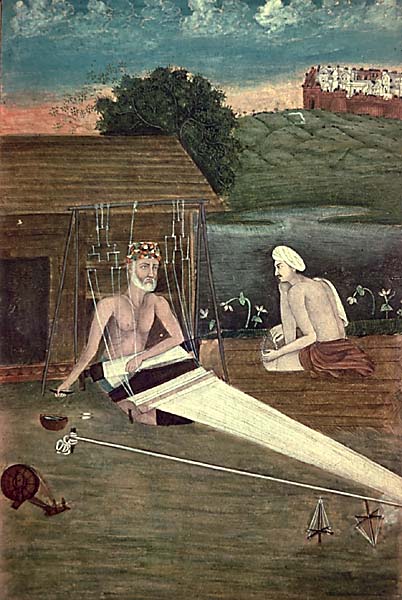
Kabir знаменитые цитаты
„Если вы хотите правду,
Я скажу вам правду:
Слушай секретный звук,
настоящий звук,
который внутри тебя.“
Kabir: Цитаты на английском языке
“O servant, where dost thou seek Me?
Lo! I am beside thee.”
Variant translation: Are you looking for me? I am in the next seat.
My shoulder is against yours.
you will not find me in the stupas, not in Indian shrine
rooms, nor in synagogues, nor in cathedrals:
not in masses, nor kirtans, not in legs winding
around your own neck, nor in eating nothing but
vegetables.
When you really look for me, you will see me
instantly —
you will find me in the tiniest house of time.
As paraphrased by Robert Bly in The Kabir Book (1977)
Songs of Kabîr (1915)
Контексте: O servant, where dost thou seek Me?
Lo! I am beside thee.
I am neither in temple nor in mosque: I am neither in Kaaba nor in Kailash:
Neither am I in rites and ceremonies, nor in Yoga and renunciation.
If thou art a true seeker, thou shalt at once see Me: thou shalt meet Me in a moment of time.
“Only he knows it who has reached that region: it is other than all that is heard and said.”
Songs of Kabîr (1915)
Контексте: They call Him Emptiness who is the Truth of truths, in Whom all truths are stored!
There within Him creation goes forward, which is beyond all philosophy; for philosophy cannot attain to Him: There is an endless world, O my Brother! and there is the Nameless Being, of whom naught can be said.
Only he knows it who has reached that region: it is other than all that is heard and said.
No form, no body, no length, no breadth is seen there: how can I tell you that which it is?
Songs of Kabîr (1915)
Контексте: It is needless to ask of a saint the caste to which he belongs;
For the priest, the warrior. the tradesman, and all the thirty-six castes, alike are seeking for God.
It is but folly to ask what the caste of a saint may be;
The barber has sought God, the washerwoman, and the carpenter —
Even Raidas was a seeker after God.
Songs of Kabîr (1915)
Контексте: O friend! hope for Him whilst you live, know whilst you live, understand whilst you live: for in life deliverance abides.
If your bonds be not broken whilst living, what hope of deliverance in death?
It is but an empty dream, that the soul shall have union with Him because it has passed from the body:
If He is found now, He is found then,
If not, we do but go to dwell in the City of Death.
If you have union now, you shall have it hereafter.
“They call Him Emptiness who is the Truth of truths, in Whom all truths are stored!”
Songs of Kabîr (1915)
Контексте: They call Him Emptiness who is the Truth of truths, in Whom all truths are stored!
There within Him creation goes forward, which is beyond all philosophy; for philosophy cannot attain to Him: There is an endless world, O my Brother! and there is the Nameless Being, of whom naught can be said.
Only he knows it who has reached that region: it is other than all that is heard and said.
No form, no body, no length, no breadth is seen there: how can I tell you that which it is?
“Admire the diamond that can bear the hits of a hammer.”
Sakhi, 168; translation by Yashwant K. Malaiya based on that of Puran Sahib.
Bijak
Контексте: Admire the diamond that can bear the hits of a hammer. Many deceptive preachers, when critically examined, turn out to be false.
Songs of Kabîr (1915)
Контексте: Do not go to the garden of flowers!
O Friend! go not there;
In your body is the garden of flowers.
Take your seat on the thousand petals of the lotus, and there gaze on the Infinite Beauty.
“Open your eyes of love, and see Him who pervades this world!”
Songs of Kabîr (1915)
Контексте: Open your eyes of love, and see Him who pervades this world! consider it well, and know that this is your own country.
“It cannot be told by the words of the mouth, it cannot be written on paper”
Songs of Kabîr (1915)
Контексте: He comes to the Path of the Infinite on whom the grace of the Lord descends: he is freed from births and deaths who attains to Him.
Kabîr says: "It cannot be told by the words of the mouth, it cannot be written on paper: It is like a dumb person who tastes a sweet thing — how shall it be explained?"
“Kabîr says, "O Sadhu! God is the breath of all breath."”
Variant translation: Kabir says: Student, tell me, what is God?
He is the breath inside the breath
As translated by Stephen Mitchell in The Enlightened Heart (1993)
Songs of Kabîr (1915)
“I have come to save the devotees. I was sent here because the world was seen in misery.”
Quoted in Tara Chand, Influence of Islam on Indian Culture, The Indian Press (Allahabad, 1946). pp.150-151. Quoted from K.S. Lal, Indian muslims, who are they, 1990.
Sakhi, 171; translation by Yashwant K. Malaiya based on that of Puran Sahib.
Bijak
“When the bride is one
with her lover,
who cares about
the wedding party?”
Azfar Hussain translations


