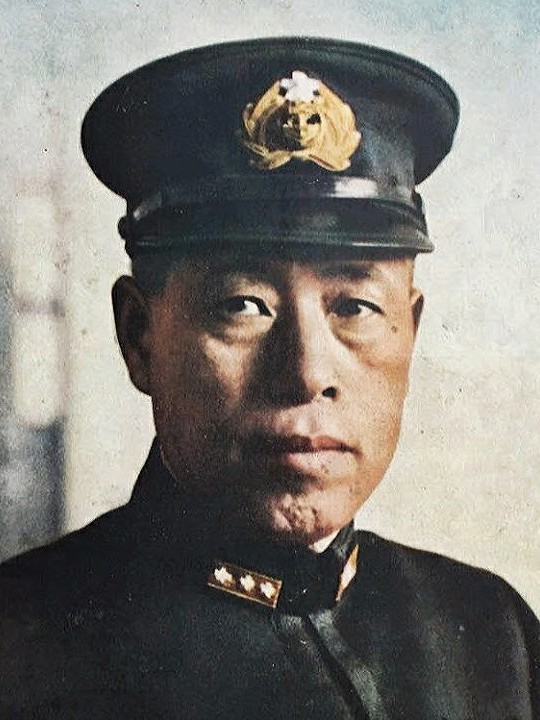
Исороку Ямамото цитаты
Исороку Ямамото: Цитаты на английском языке
“I fear all we have done is to awaken a sleeping giant and fill him with a terrible resolve.”
Statement made after the attack on Pearl Harbor by Yamamoto as portrayed in the film Tora! Tora! Tora!, this is one of the most quoted remarks attributed to him. Though it is thought that it summarizes his sentiments well, a definite source for this quote has never been provided. William Safire wrote that there is no printed evidence to support this quote. Safire's Political Dictionary, page 666. http://books.google.com/books?id=c4UoX6-Sv1AC&pg=PA666 For more information see the Wikipedia article "Isoroku Yamamoto's sleeping giant quote". <br class="br">Disputed
Statement to Japanese cabinet minister Shigeharu Matsumoto and Japanese prime minister Fumimaro Konoe, as quoted in Eagle Against the Sun: The American War With Japan (1985) by Ronald Spector. This remark would later prove prophetic; precisely six months after the attack on Pearl Harbor, the Japanese navy would suffer a major defeat at the Battle of Midway, from which it never recovered.
“You cannot invade the mainland United States. There would be a rifle behind every blade of grass.”
It has been declared this attribution is "unsubstantiated and almost certainly bogus, even though it has been repeated thousands of times in various Internet postings. There is no record of the commander in chief of Japan’s wartime fleet ever saying it.", according to source Brooks Jackson in "Misquoting Yamamoto" at Factcheck.org (11 May 2009) http://www.factcheck.org/2009/05/misquoting-yamamoto/, which cites source Donald M. Goldstein, sometimes called "the dean of Pearl Harbor historians", writing "I have never seen it in writing. It has been attributed to the Prange files [the files of the late Gordon W. Prange, chief historian on the staff of Gen. Douglas MacArthur] but no one had ever seen it or cited it from where they got it." <br class="br">Misattributed
As quoted in At Dawn We Slept (1981) by Gordon W. Prange, p. 11; this quote was stated in a letter to Ryoichi Sasakawa prior to the attack on Pearl Harbor. Minus the last sentence, it was taken out of context and interpreted in the U.S. as a boast that Japan would conquer the entire contiguous United States. The omitted sentence showed Yamamoto's counsel of caution towards a war that would cost Japan dearly.
Reply made to Ogata Taketora, the Editor in Chief of Asahi Shimbun (9 January 1942) as quoted in The Reluctant Admiral (1979) by Hiroyuki Agawa
“The fiercest serpent may be overcome by a swarm of ants.”
Statement in opposition of the planned construction of the Yamato class battleships, as quoted in Scraps of paper: the disarmament treaties between the world wars (1989) by Harlow A. Hyde. In this statement, Yamamoto implies that even the most powerful battleships can be sunk by a huge swarm of carrier planes. This remark also proved prophetic as both Yamato and Musashi would be sunk by overwhelming air attacks.
C.L. Sulzberger, The American Heritage Picture History of World War II (1966), p. 212
Disputed


