„Удача сопутствует смелым.“
Fortes fortuna adiuvat.
Из пьесы «Формион» («Phormio»).
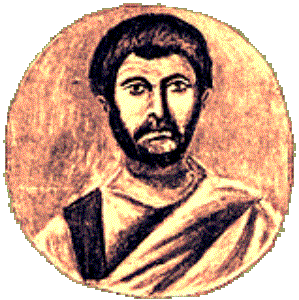
Пу́блий Тере́нций Афр — драматург, представитель древнеримской комедии. Умер в молодом возрасте, успел написать 6 комедий. Все они дошли до нашего времени. Wikipedia
„Удача сопутствует смелым.“
Fortes fortuna adiuvat.
Из пьесы «Формион» («Phormio»).
„Когда двое делают одно и то же, это уже не одно и то же.“
Duo cum faciunt idem, non est idem
Вариант: Если двое делают одно и то же, то это не одно и то же.
„Нет ничего сказанного, что было бы сказано впервые.“
Nullum est jam dictum, quod поп sit dictum prius.
„Я человек, и ничто человеческое мне не чуждо.“
Homo sum, humani nihil a me alienum puto.
Homo sum et nihil humani a me alienum puto.
Вариант: Я человек, и ничто человеческое мне не чуждо.
„Что дозволено Юпитеру, не дозволено быку.“
Quod licet Jovi (Iovi) non licet bovi. <br class="br">приписывается, но в таком виде в его пьесах не встречается, вероятно, — это средневековый парафраз оригинала «Aliis si licet, tibi non licet.» («Другим это дозволено, вам не дозволено.») из комедии «Наказывающий сам себя» <br class="br">Источник: H. J. Rose, A Handbook of Latin Literature, 1954. <br class="br">Источник: Латинские тексты комедий Теренция http://www.thelatinlibrary.com/ter.html <br class="br">Источник: Der Neue Herder, Von A bis Z, Zweiter Halbband: M bis Z, Freiburg im Breisgau 1949 (Herder Verlag), Spalte 3453, dort der Artikel „Quod licet Iovi, non licet bovi“„Quod licet Iovi, non licet bovi“
“So many men, so many opinions: to each his own way.”
Quot homines tot sententiae: suus cuique mos.
Terence Phormio
Act II, scene 4, line 14 (454).
Variant translations:
There are as many opinions as there are people: each has his own view.
There are as many opinions as there are people: each has his own correct way.
There are as many opinions as there are people: everyone has their own way of doing things.
Phormio
“It is a maxim of old that among themselves all things are common to friends.”
Terence Adelphoe
Act V, scene 3, line 18 (803).
Adelphoe (The Brothers)
“I only wish I may see your head stroked down with a slipper.”
Terence Eunuchus
Act V, scene 7, 4, line 1028.
Eunuchus
Terence Adelphoe
Act III, scene 3, line 61 (415).
Adelphoe (The Brothers)
“What now if the sky were to fall?”
Terence Heauton Timorumenos
Act IV, scene 3, line 41 (719).
Heauton Timorumenos (The Self-Tormentor)
“Moderation in all things.”
Ne quid nimis.
Terence Andria
Not anything in excess, a translation from the Greek μηδὲν ἄγαν. "Nothing in excess" as inscribed on the Temple of Apollo at Delphi.
Источник: Andria (The Lady of Andros), Line 61.
Terence Eunuchus
Act II, scene 2, 1, line 232.
Eunuchus
“Look you, I am the most concerned in my own interests.”
Terence Andria
Act IV, scene 1, line 12 (636).
Andria (The Lady of Andros)
Terence Andria
Act II, scene 5, line 15 (426).
Andria (The Lady of Andros)
“Many a time,… from a bad beginning great friendships have sprung up.”
Terence Eunuchus
Act V, scene 2, 34, line 873.
Eunuchus
“Some might, but not you.”
Aliis si licet, tibi non licet.
Terence Heauton Timorumenos
Act IV, scene 5, line 49 (797).
Variant translations:
Though others were at liberty, you are not at liberty.
Even though it is permitted for others, it isn't permitted for you.
Heauton Timorumenos (The Self-Tormentor)
Terence Eunuchus
Act II, scene 3, 28, line 319.
Eunuchus
“Hence these tears.”
Hinc illae lacrimae.
Terence Andria
Variant translation: Hence all those tears shed.
Источник: Andria (The Lady of Andros), Line 126.
“Time removes distress.”
Diem adimere aegritudinem hominibus.
Terence Heauton Timorumenos
Act III, scene 1, line 12 (421).
Variant translations:
Time heal all wounds.
Time assuages sorrow.
Heauton Timorumenos (The Self-Tormentor)


