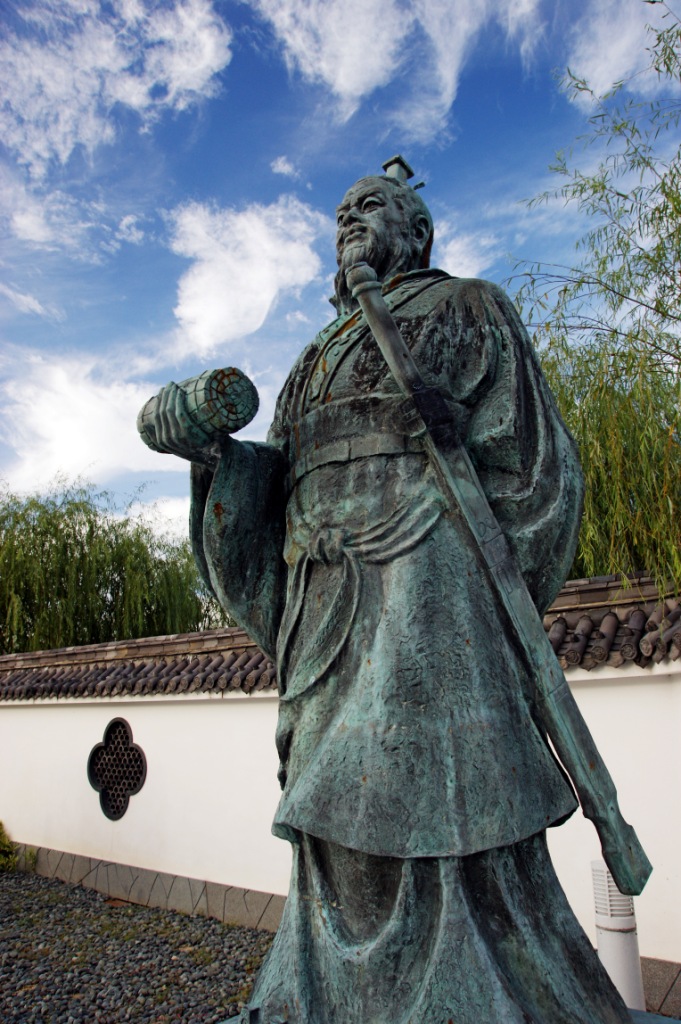
Сунь Цзы знаменитые цитаты
Сунь Цзы Цитаты о войне
«Планирование нападения»
故上兵伐謀,其次伐交,其次伐兵,其下攻城。攻城之法為不得已。
«Искусство войны»
«Начальные расчеты»
兵者,詭道也。故能而示之不能,用而示之不用,近而示之遠,遠而示之近。
«Искусство войны»
„Война любит победу и не любит продолжительности.“
«Ведение войны»
故兵貴勝,不貴久。
«Искусство войны»
«Начальные расчеты»
孫子曰:兵者,國之大事,死生之地,存亡之道,不可不察也。
«Искусство войны»
Сунь Цзы Цитаты о победе
„Непобедимость заключена в себе самом, возможность победы заключена в противнике.“
«Боевая форма»
不可勝在己,可勝在敵。
«Искусство войны»
„Возможность проиграть заключена в себе самом, возможность победы заключена в противнике.“
«Боевая форма»
不可勝在己,可勝在敵。
«Искусство войны»
Сунь Цзы цитаты
„Управлять многими — то же, что управлять немногими. Дело в организации.“
«Стратегическая мощь»
凡治眾如治寡,分數是也。
«Искусство войны»
„Тот, кто знает, когда он может сражаться, а когда не может, будет победителем.“
«Планирование нападения»
故知勝有五:知可以戰與不可以戰者勝。
«Искусство войны»
«Использование шпионов»
必索敵人之間來間我者,因而利之,導而舍之,故反間可得而用也。
«Искусство войны»
«Девять местностей»
是故始如處女,敵人開戶,後如脫兔,敵不及拒。
«Искусство войны»
«Планирование нападения»
是故百戰百勝,非善之善也﹔不戰而屈人之兵,善之善者也。
«Искусство войны»
„Знай противника и знай себя, и ты будешь непобедим.“
«Искусство войны»
Источник: Мао Цзэдун, «Относительно противоречия», август 1937. — Входит в Красную книжечку (Цитатник Цзэдуна).
«Девять местностей»
兵士甚陷則不懼,無所往則固,深入則拘,不得已則鬥。
«Искусство войны»
„Не следует путать с Сюнь-цзы (荀子; прибл. 313—238 гг. до н. э.“
также известным как Сюнь Куан).
Сунь Цзы: Цитаты на английском языке
“Keep your friends close, and your enemies closer.”
This has often been attributed to Sun Tzu and sometimes to Petrarch. It comes most directly from a line spoken by Michael Corleone in The Godfather Part II (1974), written by Mario Puzo and Francis Ford Coppola:
My father taught me many things here. He taught me in this room. He taught me: keep your friends close but your enemies closer.
Niccolò Machiavelli, who is also sometimes credited, wrote on the subject in The Prince:
It is easier for the prince to make friends of those men who were contented under the former government, and are therefore his enemies, than of those who, being discontented with it, were favourable to him and encouraged him to seize it.
Misattributed
“Fear is the true enemy, the only enemy.”
Attributed implicitly to Sun Tzu by "William Riker" in the episode The Last Outpost of the TV program Star Trek: The Next Generation, but no source for this quote predates the episode's airing in 1987.
Misattributed
“A leader leads by example not by force.”
Sun Tzu книга The Art of War
Источник: The Art of War, Chapter IX · Movement and Development of Troops
人皆知我所以勝之形,而莫知吾所以制勝之形。
Источник: The Art of War, Chapter VI · Weaknesses and Strengths
“He who knows when he can fight and when he cannot will be victorious.”
Источник: The Art of War, Chapter III · Strategic Attack
“To know your Enemy, you must become your Enemy.”
This is sometimes attributed to Sun Tzu in combination with the above quote, as well as alone, but it too has not been sourced to any published translation of The Art of War, though it is similar in concept to his famous statement in Ch. 3 : "It is said that if you know your enemies and know yourself, you will not be imperiled in a hundred battles..."
Misattributed
“In peace, prepare for war. In war, prepare for peace.”
Sometimes erroneously prepended to the opening line "The art of war is of vital importance to the State", but appears to be a variation of the Roman motto "Si vis pacem, para bellum". It's not clear who first misattributed this phrase to Sun Tzu. The earliest appearance of the phrase in Google Books is 1920, when it appeared in a pharmaceutical journal, but no attribution was given then.
Misattributed
“If your opponent is of choleric temperament, seek to irritate him.”
Источник: The Art of War, Chapter I · Detail Assessment and Planning
“The true objective of war is peace.”
This attributed to Sun Tzu and his book The Art of War. Actually James Clavell’s foreword in The Art of War http://www.scribd.com/doc/42222505/The-Art-Of-War states http://www.collegetermpapers.com/TermPapers/History_Other/Sun_Tzu_vs_The_Wisdom_of_the_Desert.shtml, “’the true object of war is peace.’” Therefore the quote is stated by James Clavell, but the true origin of Clavell's quotation is unclear. Nonetheless the essence of the quote, that a long war exhausts a state and therefore ultimately seeking peace is in the interest of the warring state, is true, as Sun Tzu in Chapter II Waging Wars says that "There is no instance of a country having benefited from prolonged warfare. It is only one who is thoroughly acquainted with the evils of war that can thoroughly understand the profitable way of carrying it on." This has been interpreted by Lionel Giles http://www.dutchjoens.info/SunTzu%20-%20Art%20of%20War.pdf as "Only one who knows the disastrous effects of a long war can realize the supreme importance of rapidity in bringing it to a close." <br class="br">Dr. Hiroshi Hatanaka, President of Kobe College, Nishinomiya, Hyōgo, Japan is recorded as saying "the real objective of war is peace" in Pacific Stars and Stripes Ryukyu Edition, Tokyo, Japan (10 February 1949), Page 2, Column 2. <br class="br">Misattributed
Источник: The Art of War, Chapter X · Terrain
“To a surrounded enemy, you must leave a way of escape.”
Источник: The Art of War, Chapter VII · Military Maneuvers
Источник: The Art of War, Chapter III · Strategic Attack
Вариант: Thus it is that in war the victorious strategist only seeks battle after the victory has been won, whereas he who is destined to defeat first fights and afterwards looks for victory.
Источник: The Art of War, Chapter IV · Disposition of the Army
“Sweat more during peace; bleed less during war.”
Sun Tzu книга The Art of War
Источник: The Art of War (Umění války)
“The art of war is of vital importance to the State.”
Sun Tzu книга The Art of War
The Art of War, Chapter I · Detail Assessment and Planning
Контексте: The art of war is of vital importance to the State. It is a matter of life and death, a road either to safety or to ruin. Hence it is a subject of inquiry which can on no account be neglected.
“Build your opponent a golden bridge to retreat across.”
This has appeared as a variant of Sun Tzu's assertion to "leave a way of escape." Tu Mu, commenting on Sun Tzu, advises, "Show him there is a road to safety..." Ch. 7; it has also recently appeared on the internet attributed to Scipio Africanus, but without citation.
Disputed
Translation by Lionel Giles
Источник: The Art of War, Chapter IV · Disposition of the Army
Variant translations
If you know others and know yourself, you will not be imperiled in a hundred battles; if you do not know others but know yourself, you win one and lose one; if you do not know others and do not know yourself, you will be imperiled in every single battle.
Know your enemy and know yourself, find naught in fear for 100 battles. Know yourself but not your enemy, find level of loss and victory. Know not thy enemy nor yourself, wallow in defeat every time.
Literal translation: Know [the] other, know [the] self, hundred battles without danger; not knowing [the] other but know [the] self, one win one loss; not knowing [the] other, not knowing [the] self, every battle must [be] lost.
Источник: The Art of War, Chapter III · Strategic Attack
Sun Tzu книга The Art of War
(zh-TW) 將弱不嚴,敎道不明,將之過也。
The Art of War, Chapter X · Terrain
Sun Tzu книга The Art of War
The Art of War, Chapter X · Terrain
Контексте: If words of command are not clear and distinct, if orders are not thoroughly understood, the general is to blame. But if his orders are clear, and the soldiers nevertheless disobey, then it is the fault of their officers.
“He who is prudent and lies in wait for an enemy who is not, will be victorious.”
Источник: The Art of War, Chapter III · Strategic Attack
Variant translations
It is best to keep one’s own state intact; to crush the enemy’s state is only second best.
Источник: The Art of War, Chapter III · Strategic Attack
“Pretend inferiority and encourage his arrogance.”
Источник: The Art of War, Chapter I · Detail Assessment and Planning
“What is essential in war is victory, not prolonged operations.”
Источник: The Art of War, Chapter II · Waging War
Probably apocryphal. This quotation does not appear in any print translation of Sun Tzu. The first citation in Google Books is from 2002; no citation in Google Books occurs in a translation of Sun Tzu.
Misattributed
Источник: The Art of War, Chapter VIII · Variations and Adaptability
“In war, numbers alone confer no advantage. Do not advance relying on sheer military power.”
Источник: The Art of War, Chapter IX · Movement and Development of Troops
Disputed


